
HyperFlow AI’s Parameter Flow
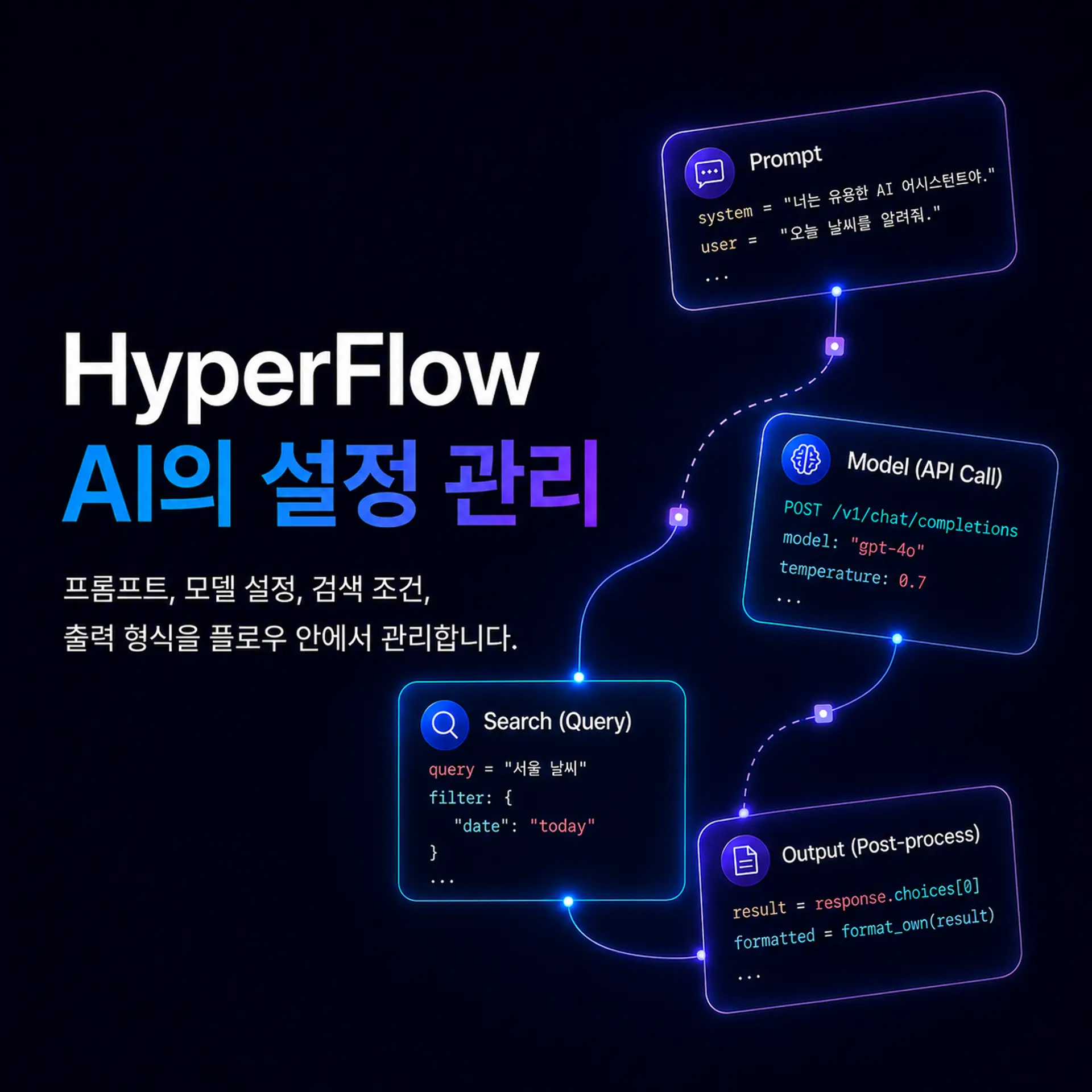
HyperFlow AI enables faster and more stable AI experimentation and operation by managing prompts, model settings, search conditions, and output formats within a flow instead of code.
AI Performance Is Not Determined by the Model Alone
When building generative AI applications, many people first think about which model to use. Choosing between OpenAI, Claude, Gemini, or open-source models is certainly important. However, in real-world services, the quality of AI is not determined by the model alone.
Even when using the same model, the quality of the response can vary greatly depending on how the prompt is written, how wide the search range is, how the temperature value is adjusted, and what format the result is output in.
In other words, the performance of a generative AI application is determined not only by the model itself, but also by the combination of many surrounding settings — the parameters.
When Parameters Are Scattered, Operation Becomes Difficult
In traditional development methods, these parameters are often scattered across multiple places. Prompts are inside the code, model settings are in the API call, search conditions are included in database queries, and output formats are managed through separate post-processing logic.
At first, this may not seem like a major problem. But once real operation begins, the situation changes.
If the answer is too long, the prompt needs to be modified. If the search results are inaccurate, the search conditions need to be adjusted. If costs increase, the model settings need to be changed. If the customer wants a different format, the output structure must be revised.
When these settings are scattered throughout the code, even a small change becomes a development task. As a result, the AI application becomes harder to experiment with and harder to improve over time.
HyperFlow Treats Parameters as a Flow
HyperFlow AI does not treat parameters as hidden settings. Instead, it treats them as a flow that can be connected and adjusted within the workflow.
In HyperFlow’s flowgraph, elements such as prompts, model settings, search conditions, output formats, and conditional branches are managed independently while being naturally connected within a single execution flow.
Users do not need to search through code to find and modify hidden settings. Instead, they can view and adjust the flow directly: what input comes in, what search process it goes through, which model settings generate the response, and what format the result is output in.
Experimentation Becomes Easier
Generative AI development is not something that ends after one build. Experiments such as changing prompts, comparing models, adjusting search ranges, and modifying output formats must be repeated continuously.
With HyperFlow, these experiments can be performed by changing flow settings instead of modifying code.
For example, users can compare different prompts for the same question, or send the same search results to multiple models to compare response quality. They can also change the number of search results to compare accuracy, or test various output formats such as JSON, tables, and summaries.
By treating parameters as a flow, AI experimentation becomes faster, more repeatable, and more systematic.
An AI System Managed by the Whole Team
When parameters exist only inside code, the AI system becomes dependent on specific developers. However, in HyperFlow, parameters are structured within the flow, making team-based operation easier.
Marketers can improve prompts to match the brand tone, planners can design branching structures based on user conditions, operations managers can adjust flows based on frequent error cases, and developers can focus on the stability and scalability of the overall system.
An AI application is no longer just code managed by one developer. It becomes an operational asset that the entire team can improve together.
AI Quality Management Starts with Parameter Management
Choosing a good model is not enough to build a good AI service. Prompts, search conditions, model settings, output formats, and conditional branches must all be managed together to create a stable AI system that can be used in real work.
HyperFlow AI does not hide these parameters inside code. Instead, it makes them visible on the flow. This allows users to understand how the AI system works, quickly adjust what needs to be changed, and repeatedly create better results.
Connecting parameters into a single flow — this is how HyperFlow AI makes generative AI applications more flexible, more stable, and more operationally ready.